
— —
Choosing a Pipe Welding Supplier: Lead Time vs. Quality
Why lead time and quality rarely move in the same direction
Choosing a pipe welding supplier often starts with a schedule, but it should never end there.
Delivery pressure is real in fabrication, plant construction, and line upgrades.
A delayed shipment can slow installation, labor planning, and downstream commissioning.
At the same time, poor weld consistency creates a different kind of delay.
Rework, fit-up problems, failed inspection, and unstable output usually cost more than a longer initial lead time.
That is why the best pipe welding supplier is not simply the fastest one.
It is the supplier that can deliver on time without losing control of process stability, accuracy, and traceable quality.
In manufacturing and processing machinery, this balance matters even more because welding quality influences later cutting, beveling, assembly, coating, and final system reliability.
What a reliable pipe welding supplier actually provides
A capable pipe welding supplier delivers more than welded parts or welding equipment.
It provides process control, production planning, technical communication, and after-sales support that fit real project conditions.
This may include automatic welding equipment, welding robots, CNC cutting systems, pipe preparation tools, and integrated line solutions.
For many buyers, the practical question is simple.
Can this supplier help maintain weld quality across different materials, batch sizes, and delivery windows?
That question becomes critical when working with carbon steel, stainless steel, or mixed production environments where prep accuracy affects weld performance.
Why the market is paying closer attention
Current sourcing decisions are shaped by shorter project cycles and tighter compliance expectations.
Many orders now involve multi-country delivery, custom specifications, and closer scrutiny of certificates and documentation.
In this context, a pipe welding supplier must show both manufacturing discipline and flexibility.
Wuxi Armada International Trade Co., Ltd operates from Wuxi, Jiangsu, about 30 minutes from Shanghai by high-speed rail.
Established in 2012, the company focuses on mechanical equipment and related products for industrial processing.
Its portfolio covers automatic welding equipment, CNC cutting machines, milling machines, CNC machine tools, lathes, welding robots, laser cutting machines, and H-beam production line equipment.
It also includes bending machines, shearing machines, plate rolling machines, leveling machines, deburring systems, pipe benders, thread rolling machines, and edge milling equipment.
That range matters because a strong supplier usually understands the full process around welding, not welding in isolation.
Exports to Southeast Asia, Europe, the Americas, and Oceania also suggest experience with varied standards and delivery expectations.
How lead time should be examined
Lead time is not only the date written on a quotation.
It reflects how the pipe welding supplier manages design confirmation, raw material supply, production loading, inspection, packing, and shipping coordination.
A short promise without production visibility is usually a warning sign.
A slightly longer but well-structured schedule is often safer.
Useful questions behind the quoted timeline
- Is the production capacity in-house or partially outsourced?
- Are critical components kept in stock or purchased after order confirmation?
- How are rush orders handled without affecting inspection steps?
- Can the supplier provide milestone updates instead of one final delivery date?
- What happens if drawings or parameters change during production?
These details reveal whether the lead time is operationally realistic or commercially optimistic.
Quality is built before the weld starts
Quality problems in pipe welding often begin in preparation, not in the arc itself.
Inaccurate bevel angles, unstable clamping, poor edge condition, and material mismatch all increase weld variation.
This is where supporting equipment becomes part of supplier evaluation.
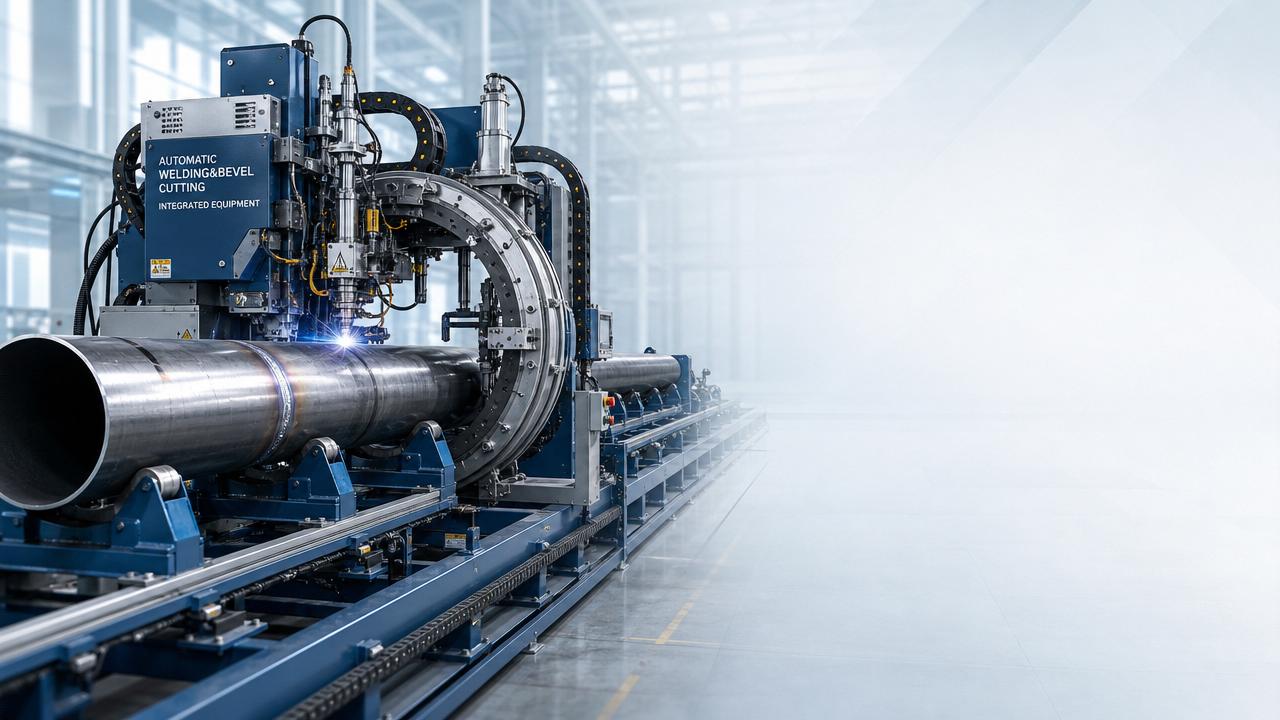
For example, pre-weld edge preparation can be strengthened with an Pipe Cutting & Beveling Machine that supports high-speed milling, automatic clamping, edge detection, feed and return movement, and adjustable bevel angles.
When a machine can handle carbon steel, stainless steel, and aluminum plates within a 6–80mm thickness range, preparation becomes more consistent across varied jobs.
Feeding speed of 0.13~1.0m/min and micron-level processing accuracy are not only technical figures.
They affect fit-up quality, weld repeatability, and the amount of manual correction required on the shop floor.
That is why a pipe welding supplier with knowledge of upstream and downstream equipment usually offers better long-term value.
A practical framework for comparing suppliers
A balanced evaluation becomes easier when lead time and quality are reviewed together.
A pipe welding supplier should be able to answer these points clearly and with evidence.
Signals that reduce sourcing risk
Several signals tend to separate dependable suppliers from convenient ones.
What is worth paying attention to
- Consistent documentation instead of vague verbal commitments.
- Stable process standards aligned with ISO9001 and EU CE expectations.
- A product range broad enough to support welding, cutting, beveling, and finishing coordination.
- Experience in export markets where packaging, compliance, and communication requirements are stricter.
- Transparent discussion of limits, not only strengths.
This is one reason companies with broader manufacturing experience are often easier to evaluate.
They can explain how one process affects another, which helps avoid isolated purchasing decisions.
Where the best decision usually lands
In most cases, the right choice is not the lowest price or the shortest quote.
It is the option that keeps total project risk under control.
A dependable pipe welding supplier combines realistic scheduling, sound preparation equipment, stable quality systems, and clear service support.
That combination usually delivers fewer surprises during installation and operation.
When comparing options, it helps to map each supplier against your actual material range, accuracy requirements, batch profile, inspection standards, and delivery milestones.
If the discussion includes weld preparation, automation, and traceable quality, the evaluation is already moving in the right direction.
The next useful step is to build a short comparison sheet, request supporting documents, and test whether each pipe welding supplier can match both schedule pressure and long-term performance expectations.