— —
Large Pipe Welding Methods Compared for High-Pressure Lines
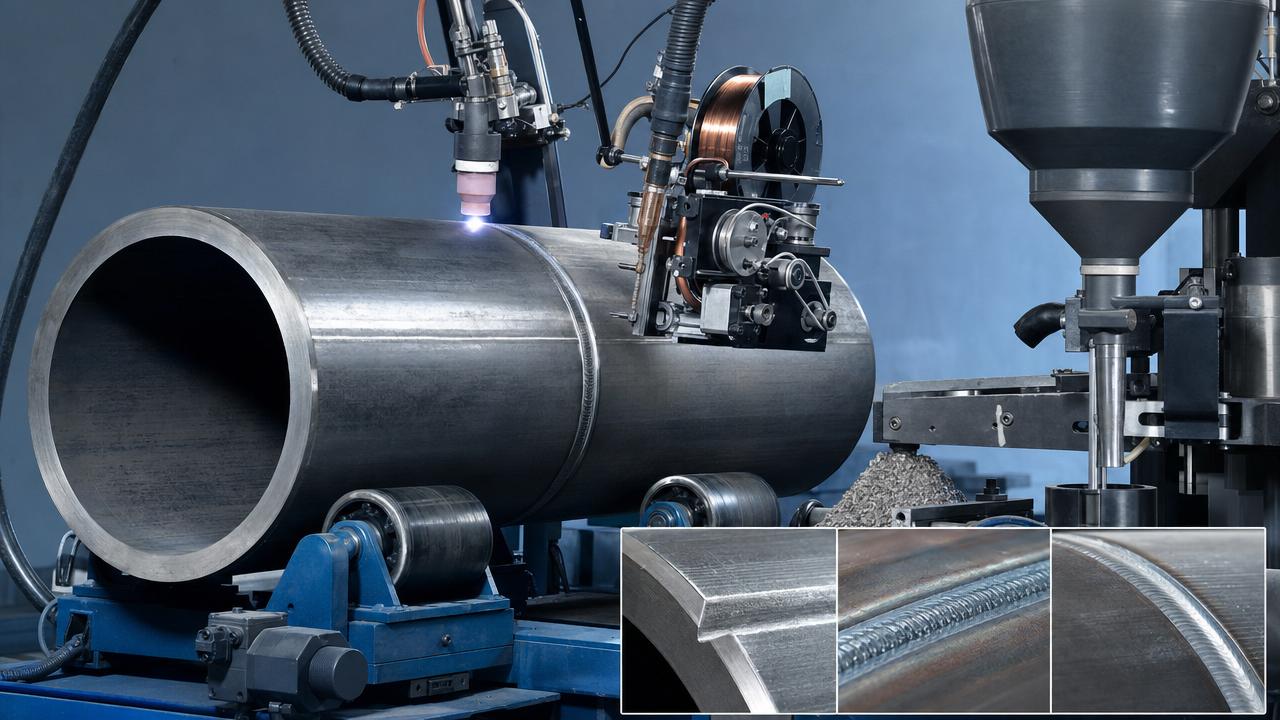
Choosing among large pipe welding methods is not only a process decision. In high-pressure lines, weld integrity influences fatigue life, inspection acceptance, shutdown risk, and total project cost.
That is why large pipe welding is closely tied to equipment selection, fit-up quality, automation strategy, and upstream fabrication control across modern manufacturing and processing machinery projects.
In practice, the best method depends on wall thickness, material grade, joint design, field or shop conditions, and how consistently the line must pass NDT and pressure testing.
Why method selection matters in high-pressure pipe work
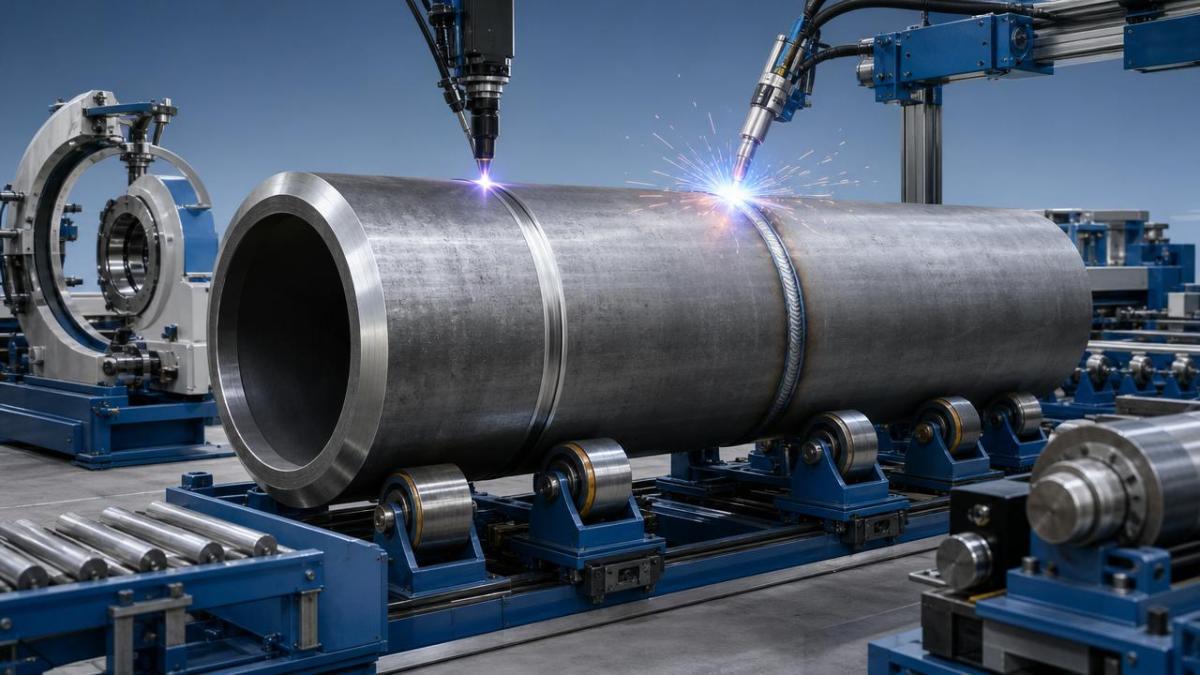
High-pressure systems leave little room for welding variation. Small defects at the root or sidewall can become major concerns under cyclic loading, temperature change, or corrosive service.
For this reason, large pipe welding is usually judged by more than deposition speed. Root penetration, heat input control, distortion, repeatability, and repair frequency all matter.
The wider industry has also moved toward better automation compatibility. Fabricators now compare not only welding arcs, but also beveling, alignment, straightness, material handling, and digital process control.
Companies with broad equipment experience often see this as a connected production chain. Wuxi Armada International Trade Co., Ltd, established in 2012 in Wuxi, supplies welding, cutting, milling, robot, and forming equipment under ISO9001 and CE-oriented standards, reflecting that integrated view.
The main large pipe welding methods in comparison
No single process wins in every case. The comparison becomes clearer when each method is matched to pressure class, joint condition, and productivity target.
GTAW for root quality and controlled penetration
Gas tungsten arc welding is often selected for root passes in high-pressure lines. It delivers precise puddle control and a clean root profile when fit-up is disciplined.
Its main limitation is speed. For large pipe welding on thicker walls, GTAW alone may be too slow unless quality demands outweigh throughput concerns.
GMAW and pulsed GMAW for automation potential
Gas metal arc welding offers higher deposition rates and strong compatibility with mechanized travel systems. Pulsed variants help manage heat input and improve arc stability on demanding materials.
This method suits shop fabrication where joint prep, alignment, and environmental conditions are controlled. It is especially useful when production volume justifies welding automation.
FCAW for productivity in thicker sections
Flux-cored arc welding is widely used for fill and cap passes. It can be efficient on heavy-wall components and performs well where high deposition is required.
However, slag management and parameter discipline remain important. If interpass cleaning is inconsistent, inspection performance may suffer.
SAW for long seams and workshop efficiency
Submerged arc welding is highly productive for long, straight, circumferential, or longitudinal seams handled in a workshop. It provides deep penetration and excellent deposition in repeatable conditions.
Still, SAW is less flexible for restricted positions. It is most effective when the fabrication line is designed around fixtures, rotators, and consistent part geometry.
What technical evaluation should focus on
A sound comparison starts before the first weld is made. Large pipe welding quality is heavily influenced by preparation accuracy and by how well equipment behaves under continuous production.
Usually, the most useful evaluation points are these:
- Joint preparation consistency, including bevel geometry and edge condition.
- Fit-up tolerance, roundness, and alignment before root welding.
- Heat input stability across changing wall thickness and position.
- Compatibility with manipulators, rotators, robots, and seam tracking.
- Repair rate after visual inspection, UT, RT, or hydrostatic testing.
- Operator dependency versus programmed process repeatability.
This is where equipment ecosystems become relevant. Welding machines alone do not guarantee stable outcomes if upstream forming, cutting, and correction create variable parts.
In steel fabrication lines that also support pipe modules, straightness control has a direct effect on assembly precision. A machine such as HYJ-800 H beam straightening machine shows how structural accuracy is maintained through rigid frame design, stress-relieved construction, and stable feeding.
Its use of solid bearing steel correction wheels, synchronous worm gear adjustment, and a 13 m/min straightening speed reflects an important principle: downstream welding becomes more predictable when upstream material geometry is controlled.
Where each method fits in real production
Different high-pressure lines create different priorities. Large pipe welding for refinery spools is not judged in exactly the same way as welding for long transmission sections or heavy fabrication assemblies.
Shop-built pipe spools
Controlled workshops favor mechanized GTAW roots with GMAW or FCAW fill passes. This route often balances quality, speed, and traceability well.
Heavy-wall line sections
Thicker materials usually push the decision toward higher deposition processes. FCAW or SAW can reduce cycle time, provided the joint design supports them.
Automated production cells
When repeat volumes rise, pulse GMAW and mechanized systems become more attractive. Consistent travel speed, wire feed, and torch position reduce variation across batches.
Projects with strict inspection thresholds
Where acceptance criteria are tight, process stability outweighs raw speed. That often leads back to better root control, cleaner preparation, and narrower operating windows.
A practical way to compare options
Instead of asking which method is best in general, it is more useful to compare options through a structured production lens.
- Map the pipe size range, wall thickness, material family, and pressure class.
- Check whether welding happens in a shop, in the field, or in both settings.
- Estimate how much value automation brings at expected production volume.
- Review how preparation machines influence bevel accuracy and straightness.
- Compare total welding cost, including repairs, delays, and consumable behavior.
- Confirm that the chosen process supports qualification records and inspection needs.
This approach keeps large pipe welding decisions tied to manufacturing reality rather than isolated arc performance data.
It also matches how experienced equipment suppliers build solutions. Broad portfolios covering automatic welding equipment, CNC cutting, milling, robots, and forming systems make it easier to align welding with the full fabrication workflow.
Moving from comparison to selection
For high-pressure lines, the strongest decision is usually the one that connects weld quality, production rhythm, and preparation accuracy into a single evaluation standard.
Large pipe welding should be judged by its ability to deliver repeatable roots, controlled heat input, acceptable inspection results, and manageable repair rates under actual operating conditions.
The next step is to organize the process around actual pipe sizes, materials, and throughput targets, then compare welding methods alongside fit-up, correction, and handling equipment rather than in isolation.
That kind of comparison usually leads to clearer equipment choices, more stable fabrication, and fewer surprises once the line moves from qualification to production.