
— —
Radial Drilling Machine vs Bench Drill: Key Differences
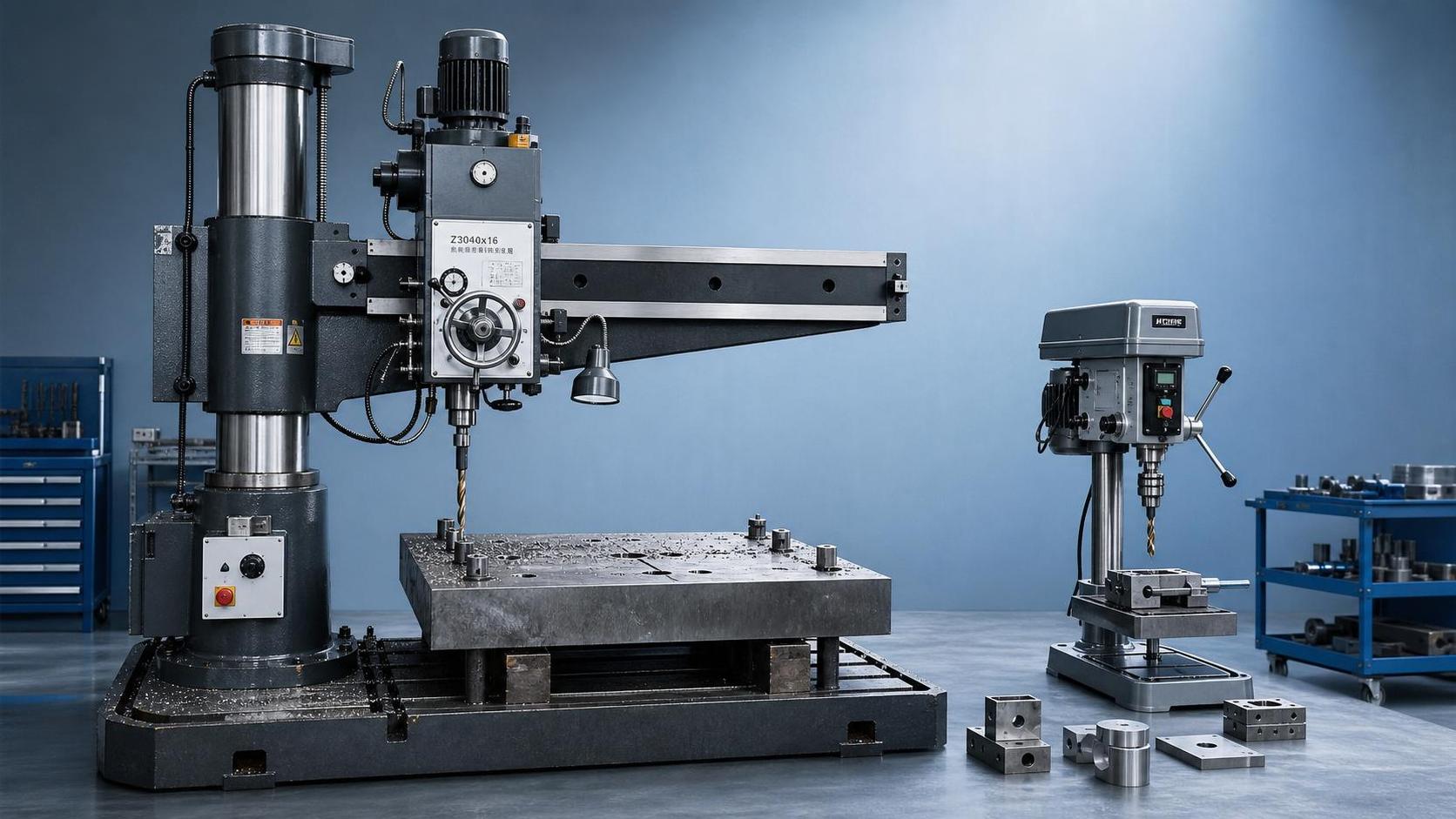
Why does the choice between these two drills matter so much?
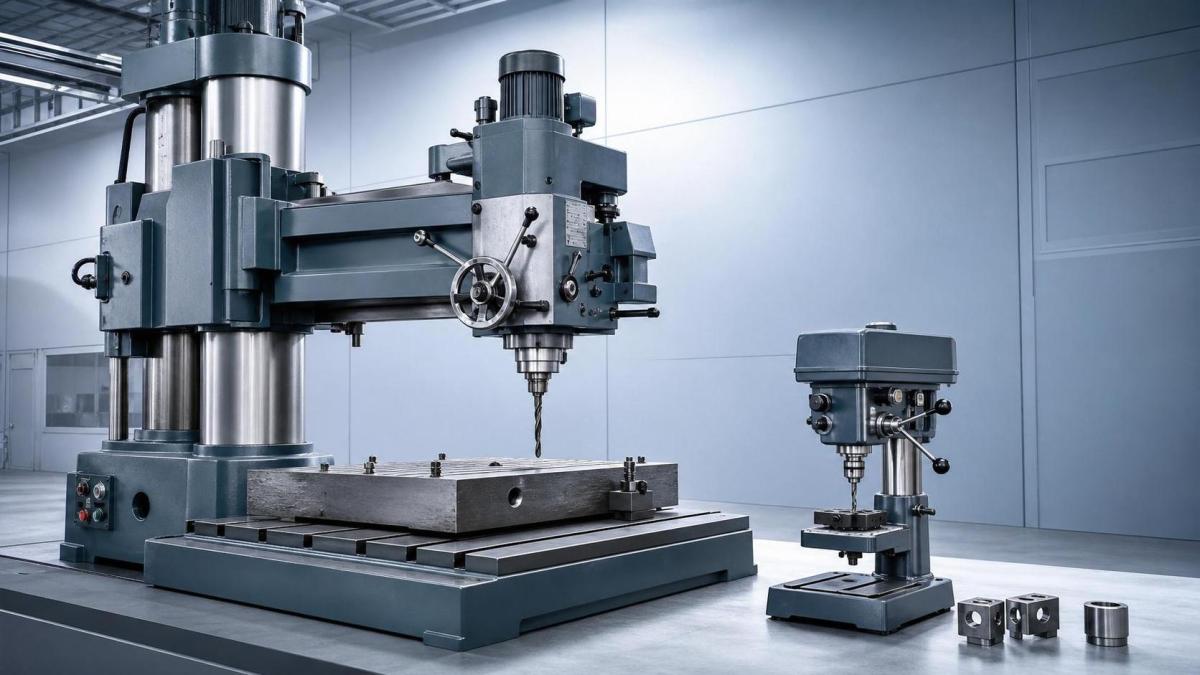
A drilling machine is never just a basic hole-making tool.
In metalworking, the wrong choice can limit accuracy, slow setup, and increase handling risk.
That is why the comparison between a radial drilling machine and a bench drill gets real attention.
Both machines drill, ream, tap, and countersink in certain conditions.
But they serve very different workshop realities.
A bench drill is compact and direct.
A radial drilling machine is built for reach, heavy parts, and flexible positioning.
In actual production, that difference affects fixturing, floor space, cycle time, and operator effort.
For companies dealing with fabricated steel, machine parts, pipes, or structural components, the decision should be practical, not theoretical.
Wuxi Armada International Trade Co., Ltd has worked across machinery categories since 2012.
Its product scope covers drilling, milling, cutting, welding, forming, and other fabrication equipment under ISO9001 and CE-oriented quality control.
That broader machinery background matters because drilling equipment is rarely selected in isolation.
So what is the real difference between a radial drilling machine and a bench drill?
The shortest answer is mobility of the spindle relative to the workpiece.
A bench drill usually has a fixed head and a smaller worktable.
The operator moves the part into position.
A radial drilling machine allows the drill head to move along an arm.
The arm itself can swing around a column and adjust in height.
That means the tool comes to the workpiece, not only the other way around.
This becomes critical when parts are wide, tall, heavy, or awkward to clamp repeatedly.
A bench drill is often enough for maintenance work, light fabrication, and small-batch drilling.
A radial drilling machine is more common for plates, machine frames, flanges, castings, and structural steel members.
The difference is easier to see in a practical comparison.
If the part can be lifted, indexed, and clamped quickly, a bench drill often stays economical.
If handling the part becomes the main job, a radial drilling machine usually makes more sense.
When is a bench drill still the better option?
A larger machine is not automatically the smarter machine.
A bench drill remains a strong choice when the work is repetitive, small, and straightforward.
It is easier to install, easier to power, and usually cheaper to maintain.
For thin plates, brackets, repair parts, or low-thickness stock, it often delivers enough precision.
Setup can also be faster because the machine is simple.
There are fewer moving structures to align and lock.
That said, its limits appear quickly when the hole pattern spreads across a large surface.
The operator may need to unclamp and reposition the part several times.
Every repositioning step introduces time loss and potential misalignment.
So the bench drill wins on simplicity, but mainly within a controlled size range.
Where does a radial drilling machine justify its higher cost?
The value of a radial drilling machine shows up when material handling is expensive or slow.
Think of base plates, welded structures, large rings, gearbox housings, or pressure vessel components.
These parts may be too heavy to reposition safely after every hole.
A radial drilling machine reduces that problem by bringing the spindle across the work area.
It also helps when the hole location changes from job to job.
This is common in fabrication shops that handle custom orders rather than uniform mass production.
More importantly, the machine can improve consistency because the workpiece remains clamped once.
That reduces cumulative positioning error.
In workshops that also use welding positioners or rotators, process planning often follows the same principle.
Keep the part stable, and move the tool or controlled support instead.
For example, a shop handling cylindrical assemblies may pair drilling, fit-up, and welding support systems.
A related example is Bolt adjusting welding rotator, used for cylinder work piece rotating and big diameter pipe butt welding.
With rated loads from 2T to 800T and frequency conversion speed control, such equipment reflects the same efficiency logic.
Stable support, controlled movement, and lower labor intensity often improve both quality and throughput.
What should be checked before choosing a radial drilling machine?
This is where many comparisons become too shallow.
The purchase decision should not stop at “large parts equal radial drill.”
Several details decide whether the investment actually pays back.
- Maximum workpiece dimensions, not just weight.
- Hole diameter range and material hardness.
- Reach requirement across the full drilling area.
- Need for tapping, reaming, or countersinking.
- Clamping method and crane access around the machine.
- Available foundation space and power supply.
One common mistake is focusing only on spindle power.
Reach, arm rigidity, and column stability can matter just as much.
Another mistake is underestimating part loading flow.
If the machine is correct but the surrounding handling path is poor, the gain disappears.
That is why experienced machinery suppliers often discuss the full workflow.
The drilling machine, the fixture method, and adjacent fabrication equipment need to fit together.
Are there cost or maintenance differences that people overlook?
Yes, and they matter more over time than the initial quote.
A bench drill usually costs less to buy, transport, install, and service.
Its maintenance routine is also simpler.
A radial drilling machine brings more mechanical structure, more locking systems, and greater setup responsibility.
That can raise ownership cost.
Still, judging by purchase price alone is risky.
If a larger machine cuts repeated lifting, re-clamping, and correction work, the total production cost may fall.
This is especially true for medium-batch heavy fabrication.
It helps to compare the two options through a simple decision lens.
A good evaluation should include uptime, operator effort, accuracy stability, and future workload growth.
What is the most sensible next step if you are still comparing options?
Start with the part, not the catalog.
List the largest workpiece, the smallest batch, the widest hole spacing, and the heaviest handling step.
That single exercise usually clarifies whether a bench drill is enough.
If part movement dominates labor time, a radial drilling machine deserves serious consideration.
If jobs stay compact and repeatable, the smaller machine may remain the smarter investment.
It also helps to compare drilling needs with the rest of the fabrication line.
Shops that already manage welding, pipe handling, or vessel production often benefit from coordinated equipment planning.
In those environments, support systems such as a second Bolt adjusting welding rotator example may be reviewed alongside drilling equipment, especially for CE-oriented projects.
The key point is simple.
A bench drill suits lighter, smaller, and more direct work.
A radial drilling machine earns its place when reach, rigidity, and reduced repositioning create measurable value.
Before making a final decision, compare actual parts, handling methods, power needs, and expected workflow changes over the next few years.
That approach leads to a more reliable equipment choice than comparing machine size alone.